


 Continue with Google
Three ways to plan a gift
Most people give in one of three ways, and the planner has a place for each. Pick the one that matches how the money really leaves your hands.
- A regular gift in your budget. A monthly donation, a yearly pledge or gifts to family that you make every year: a line in your budget, such as Gifts and giving. It is part of your spending, rises with inflation like the rest of your budget, and is paid from whatever the plan withdraws.
- A one-off or a few years of giving on a card. A building-fund pledge, a large gift in one year, five years of help with a grandchild's college: an Extra Withdrawals card with Destination Spend it. It is drawn on top of your spending.
- Straight from an IRA to a charity (a QCD). From 70½, in a US plan: an Extra Withdrawals card set to Give it to charity (QCD). The gift is never income, so it lowers your taxes, and it counts toward your required minimum distribution. US
Money you leave to charity when you die is set on the Estate tab instead: see Leaving part to charity.
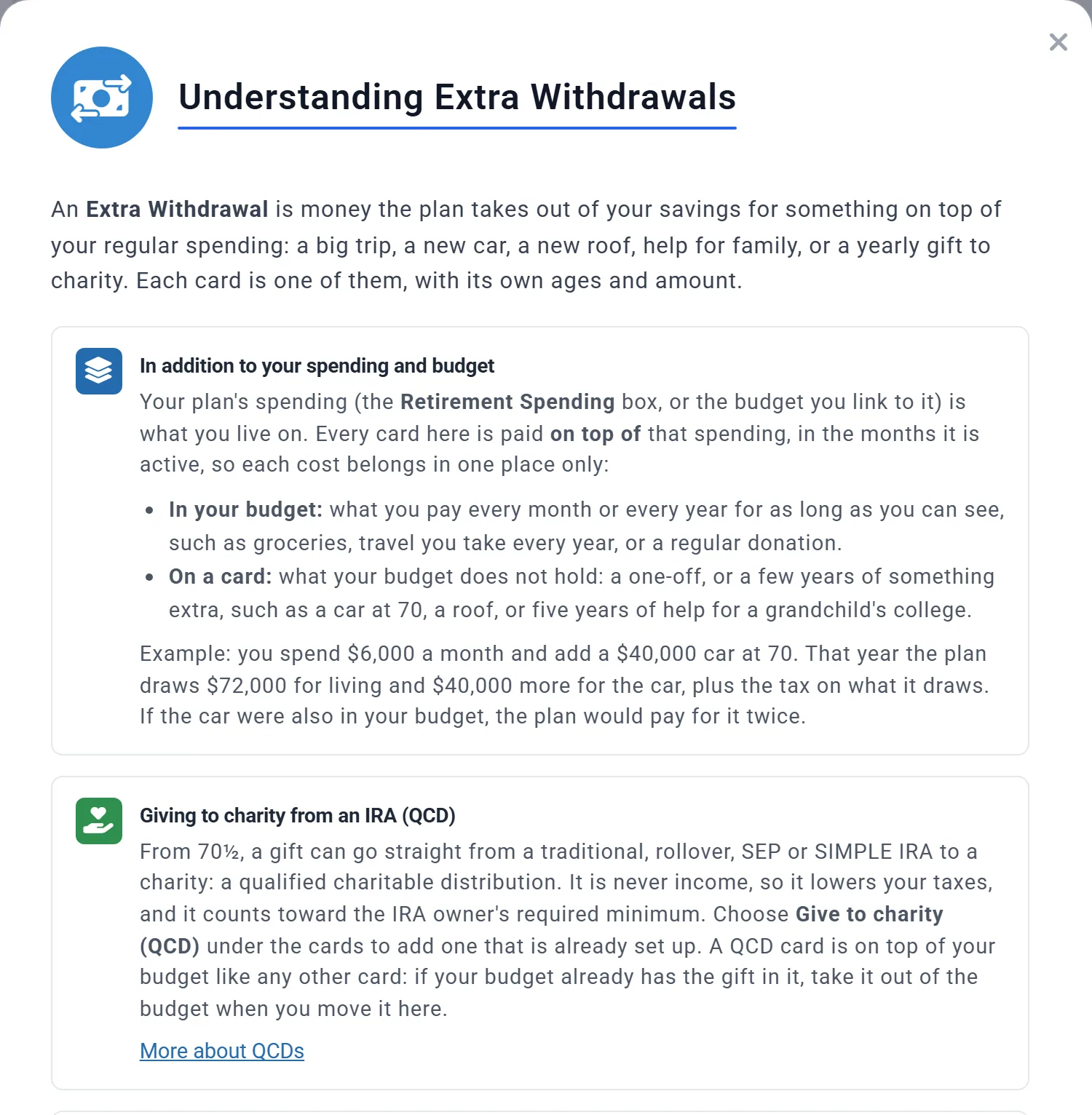
On top of your budget, never in both
Your spending (the Retirement Spending box, or the budget you link to it) is what you live on. Every Extra Withdrawals card, a QCD included, is paid in addition to that spending, in the years it is active. So each gift belongs in one place only. If it is in your budget and on a card, the plan gives it twice.
Chris and Jamie's budget has Gifts and giving at $300 a month. From 71 Chris can give the same $3,600 a year (in today's dollars, like the budget line) from the IRA as a QCD, so they do two things together:
- Add a QCD card for $3,600 a year from 71 (the next section shows how).
- End the budget's Gifts and giving row when the QCD starts, at Chris's 71st birthday (see When a row starts and stops). Until then the gifts stay in the budget; from 71 they come from the IRA.
The card helps: when your linked budget has a line that looks like giving, a QCD card names it, as in the screenshot below (4). The ? beside the box's title and beside Give to charity (QCD) explain the same thing in more detail.
Giving from an IRA: the QCD US
A qualified charitable distribution (QCD) sends money straight from an IRA to a charity. The gift never counts as income, which matters even when you take the standard deduction:
- Federal and state tax are lower, because the gift is left out of your income (AGI).
- The taxed part of Social Security and Medicare premiums (IRMAA, two years later) can be lower too, since both follow your income.
- From the year required minimum distributions start, the gift counts toward the IRA owner's minimum, so that much less of the minimum is taxed.
The same money given from your budget is spending: the plan withdraws it like any spending, and a withdrawal from a pre-tax account is taxed.
Who can give, and how much
- The IRA's owner must be 70½ in the month of the gift.
- It must come from a Traditional, Rollover, SEP or SIMPLE IRA, never a 401(k), 403(b) or Roth account. A SEP or SIMPLE IRA qualifies only in a year no employer money goes into it.
- Each person can give up to $111,000 a year (2026; the limit rises with inflation).
- It must go to a charity directly. A donor-advised fund or a private foundation cannot receive a QCD.
Add a QCD in one click US
- Turn on the Extra Withdrawals box (the Add box, Expenses), if you have not already.
- Choose Give to charity (QCD) beside + Add withdrawal. The button shows when your plan has an IRA a QCD can come from, for you or your spouse, and its owner reaches 70½ before the plan ends.
- Type the yearly Amount. The card is already set up: a QCD from your IRA, from the first age a QCD can start to the end of your plan, with Grows with inflation on. Change the ages if your giving starts or stops at other ages.
If the box only holds its empty starting card, that card becomes the gift. With more than one IRA, the card opens its More options so you can choose the IRA under Source Account.
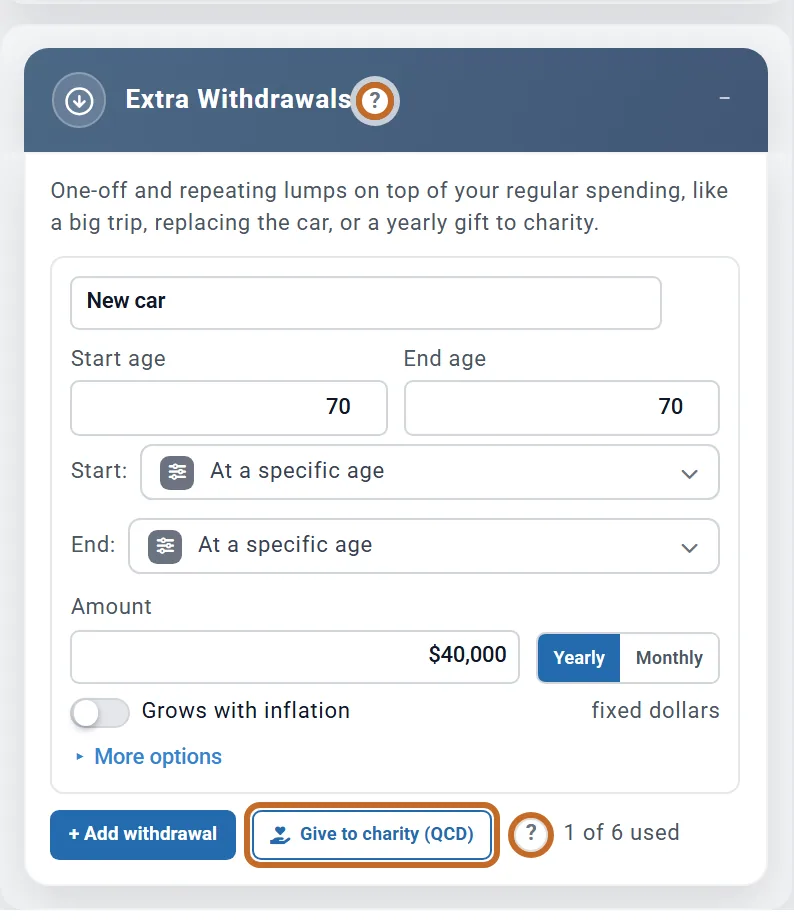
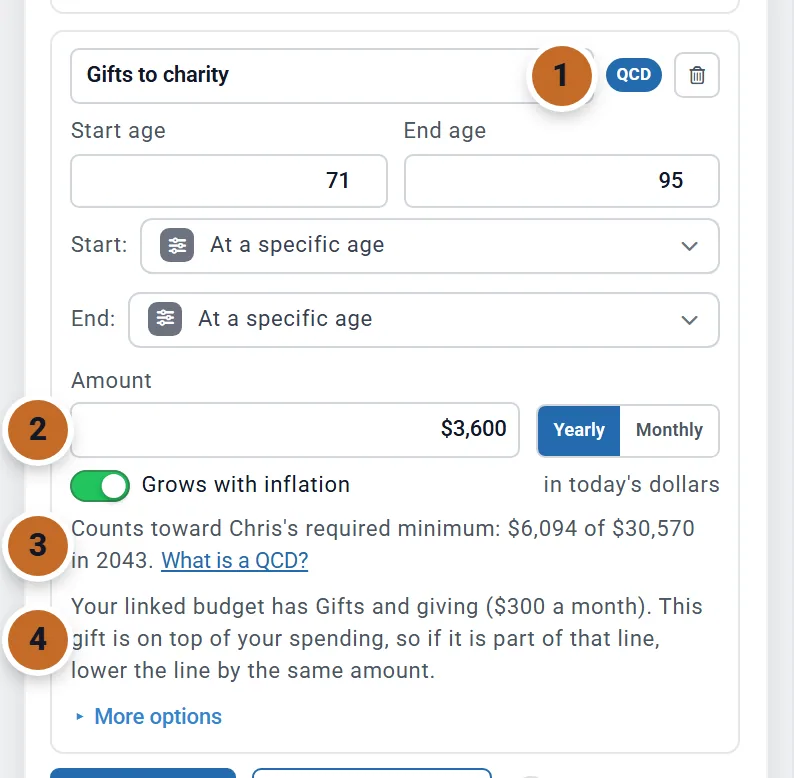
Chris's card after typing $3,600:
- The QCD chip says this card is a gift from an IRA.
- The amount: $3,600 a year, from 71 to 95. Under it, Grows with inflation is on, as on every new card: the $3,600 is in today's dollars and each year's gift rises with inflation, like the budget line it replaces.
- A line from the last run: "Counts toward Chris's required minimum: $6,094 of $30,570 in 2043." The $6,094 is the $3,600 grown with inflation by 2043. If a gift cannot be made (before 70½, over the yearly limit, the IRA has run out), this line says so instead.
- Their linked budget has Gifts and giving ($300 a month), so the card reminds them to lower that line by the same amount.
Turn a card into a QCD US
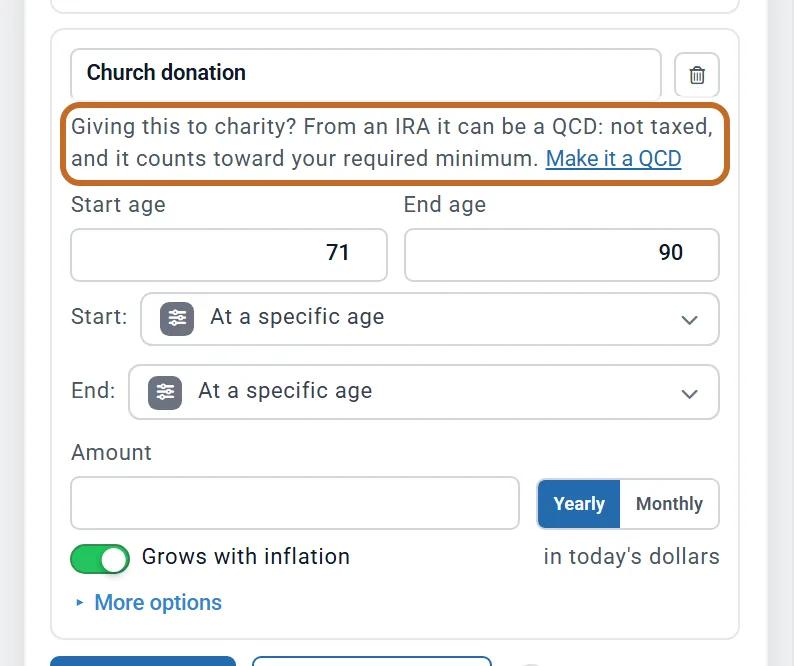
A card you have named like a gift (a church, a charity, a donation, a tithe) that is still set to Spend it offers the switch under its name: "Giving this to charity? From an IRA it can be a QCD: not taxed, and it counts toward your required minimum." Choose Make it a QCD and the card becomes a QCD from your IRA.
The line shows only when the card runs to an age when an IRA owner is 70½ or older, and never for a card named for a donor-advised fund.
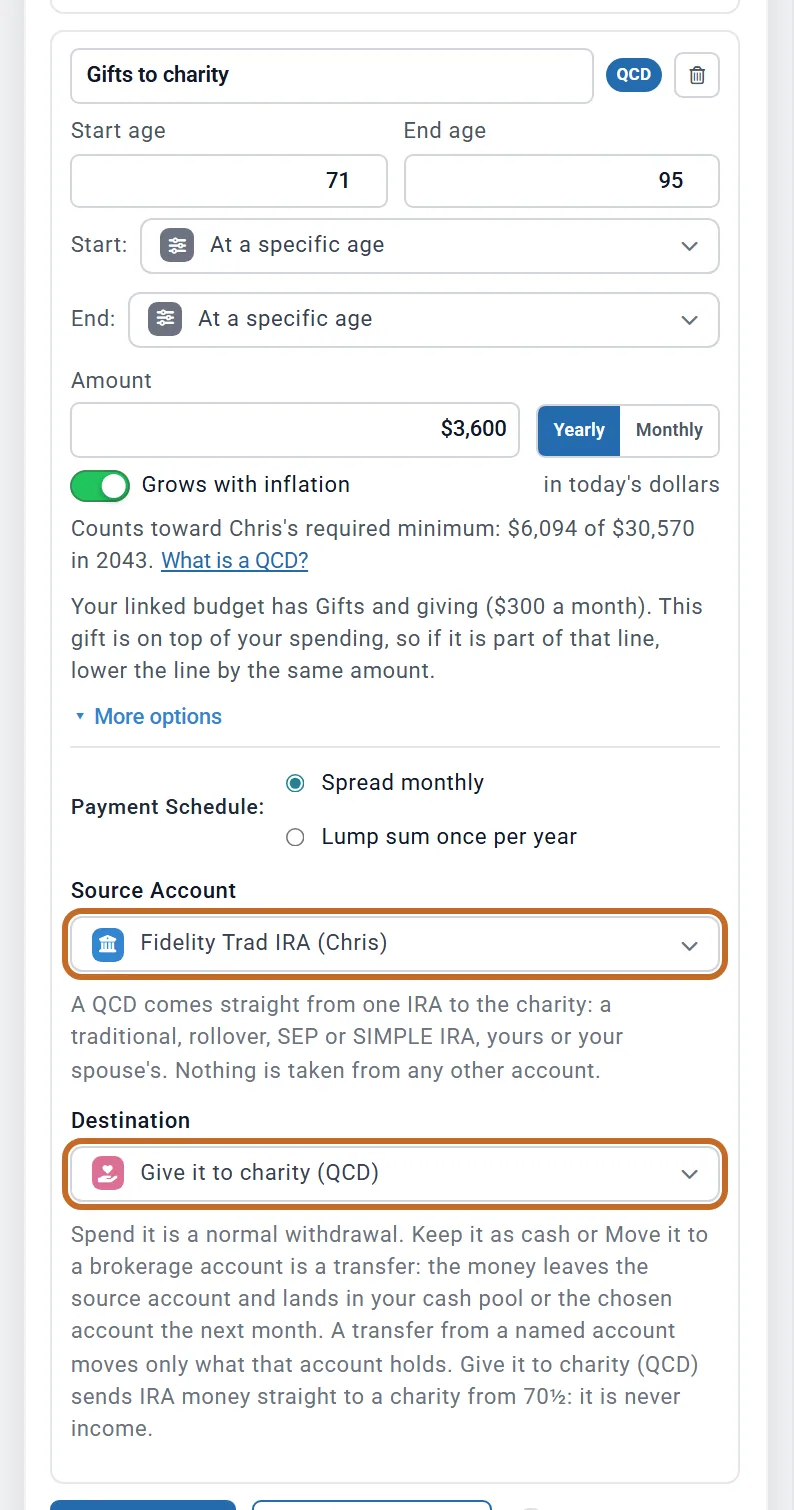
Either way, the card's More options show what makes it a QCD: Destination is Give it to charity (QCD), and Source Account lists only the IRAs a QCD can come from (here Chris's Fidelity Trad IRA (Chris)). You can set these by hand on any card too.
A QCD card is spread over the year's twelve months unless you choose Lump sum once per year. With Grows with inflation on, as on a new card, its amount is in today's dollars and rises with inflation; off, it is a fixed number of dollars.
See your giving in your results
The Withdrawals chart
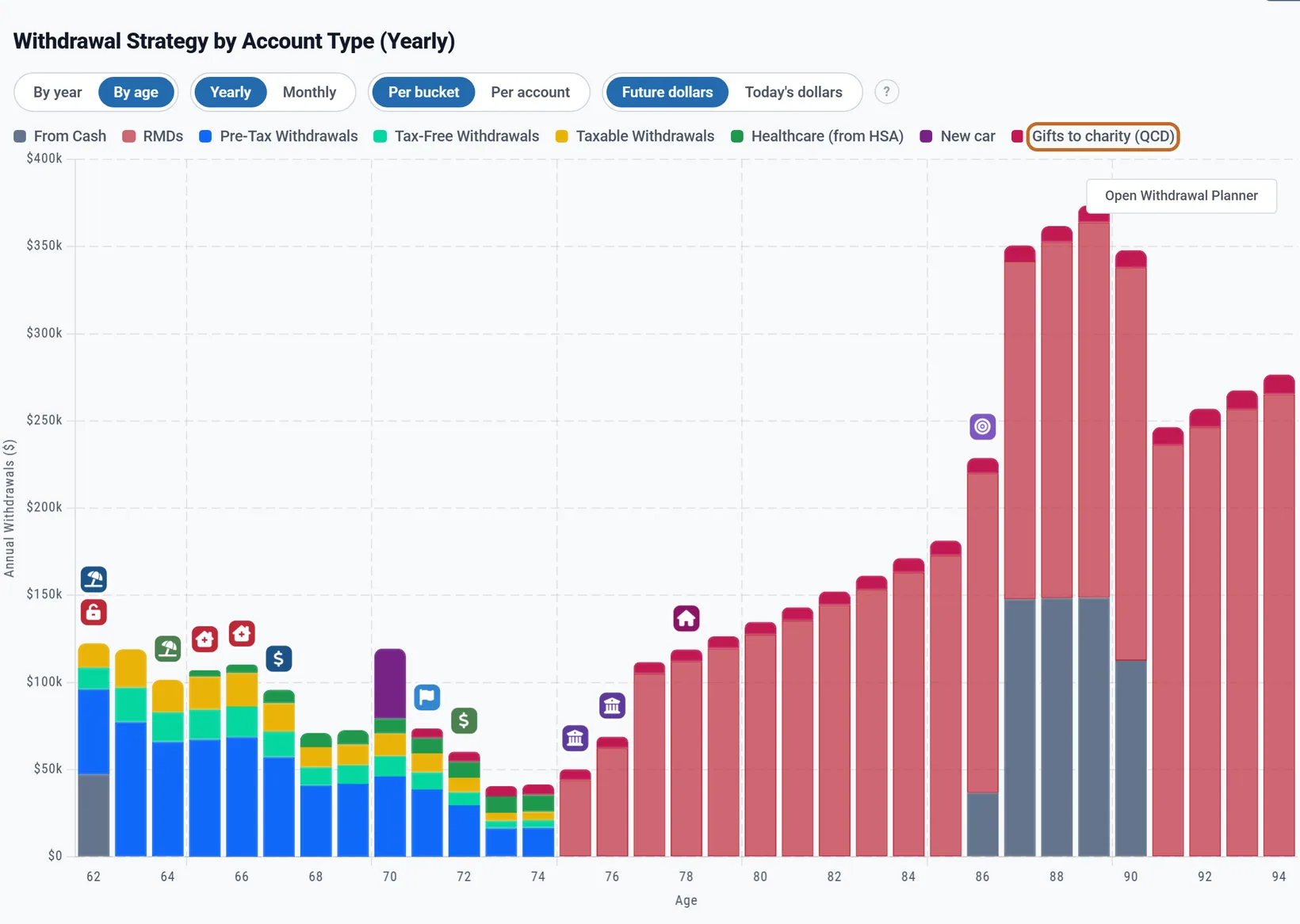
The card has its own band, Gifts to charity (QCD), on each year it gives: from 71 here. Because the gift counts toward the required minimum, the RMDs band beside it is smaller by the same amount, so the money is never shown twice.
The RMDs chart Planner+
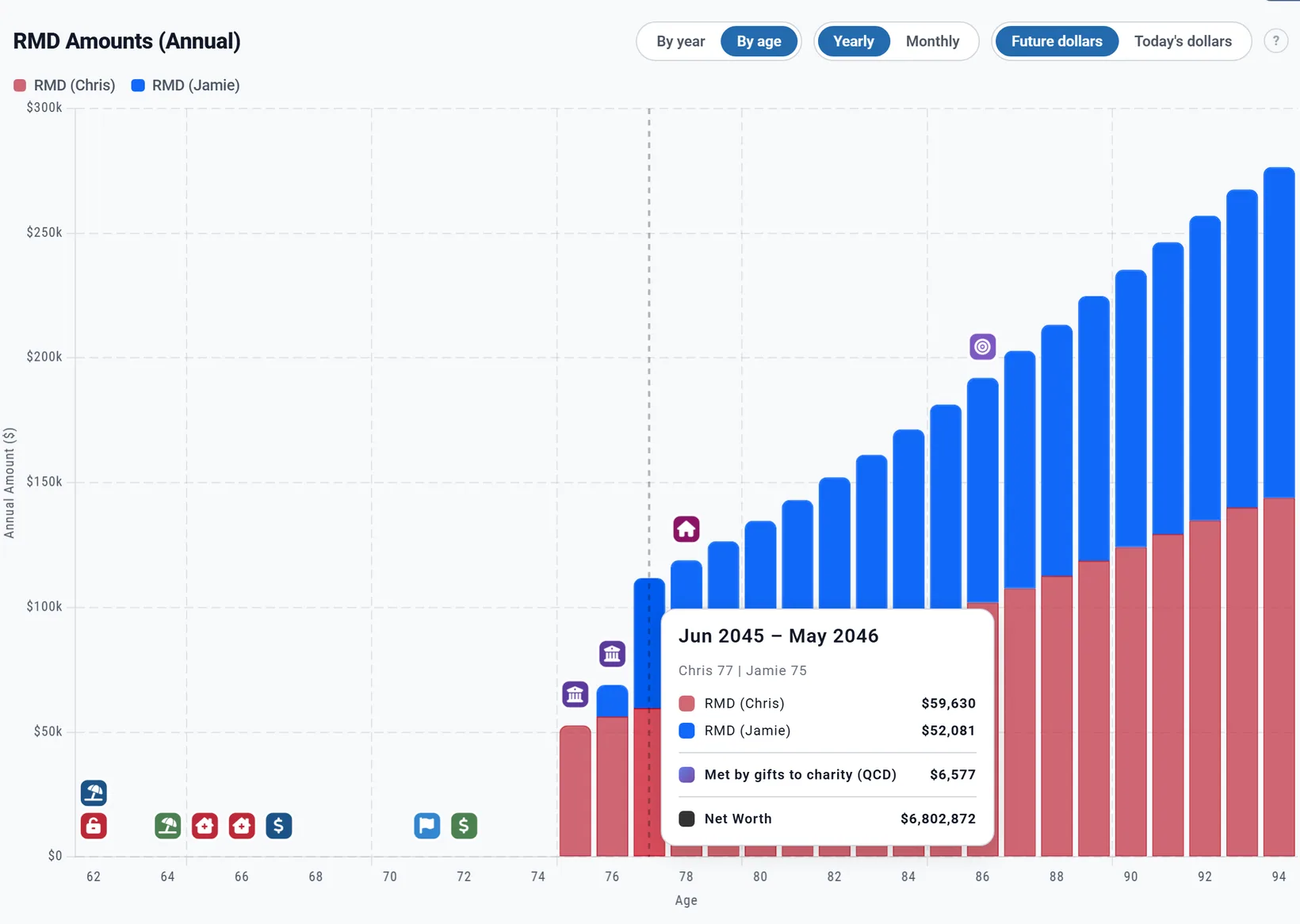
Hover over a year (Dashboard, More, RMDs). The tooltip lists each person's minimum and what the gifts met of it: at 77, "Met by gifts to charity (QCD): $6,577" of Chris's $59,630 (the $3,600 of today's dollars, grown with inflation).
The Cash Flow chart
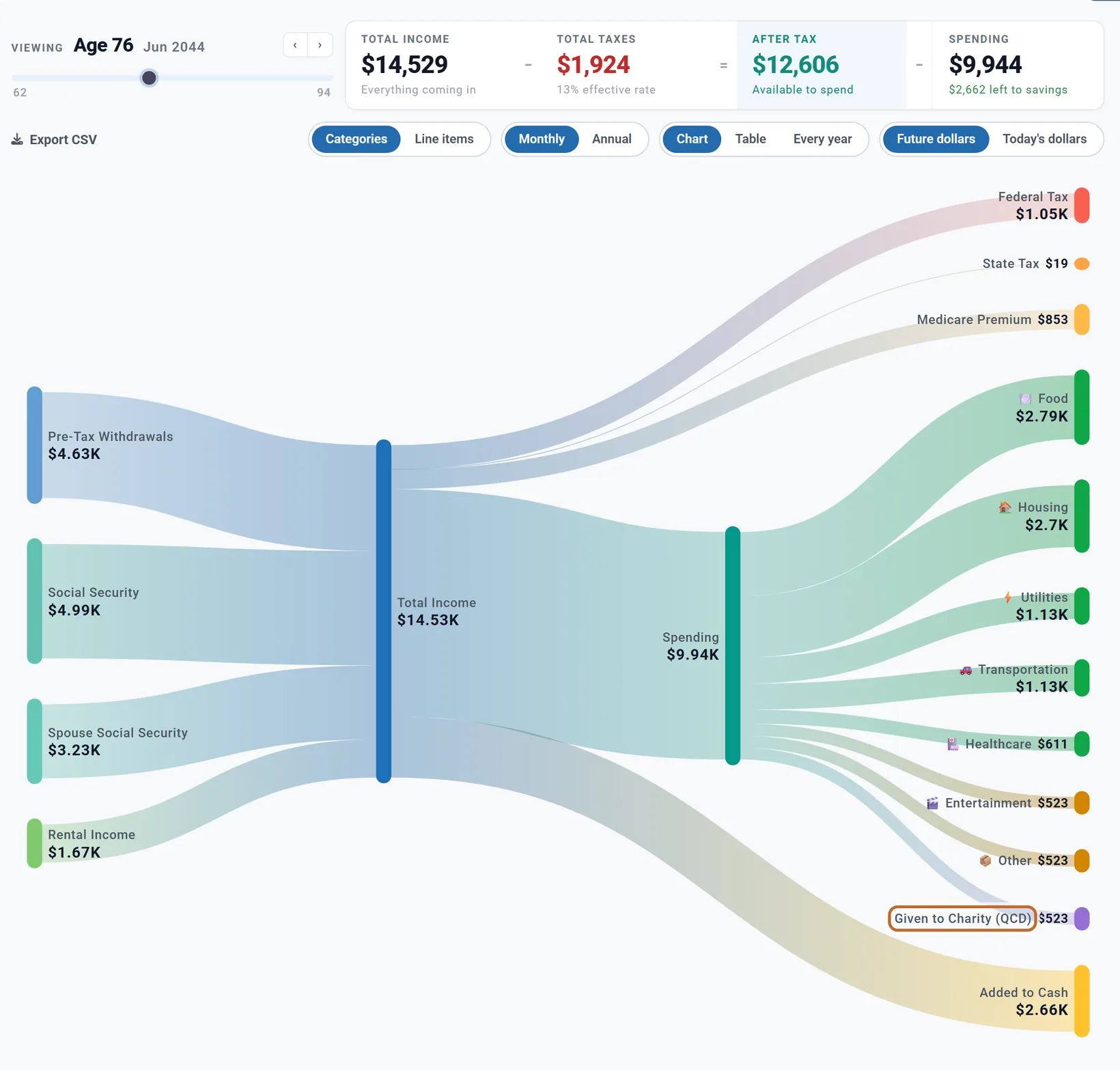
Move the age slider to a year with a gift: Given to Charity (QCD) has its own node beside your spending, never inside a budget category. At 76 it is $523 a month: the $300 a month of today's dollars, grown with inflation.
The Retirement Year Detail
In the Retirement Spending box, the year's statement lists the gift as Less: Given to Charity (QCD), apart from what you spent and never inside Taxes Paid.
Tax Details
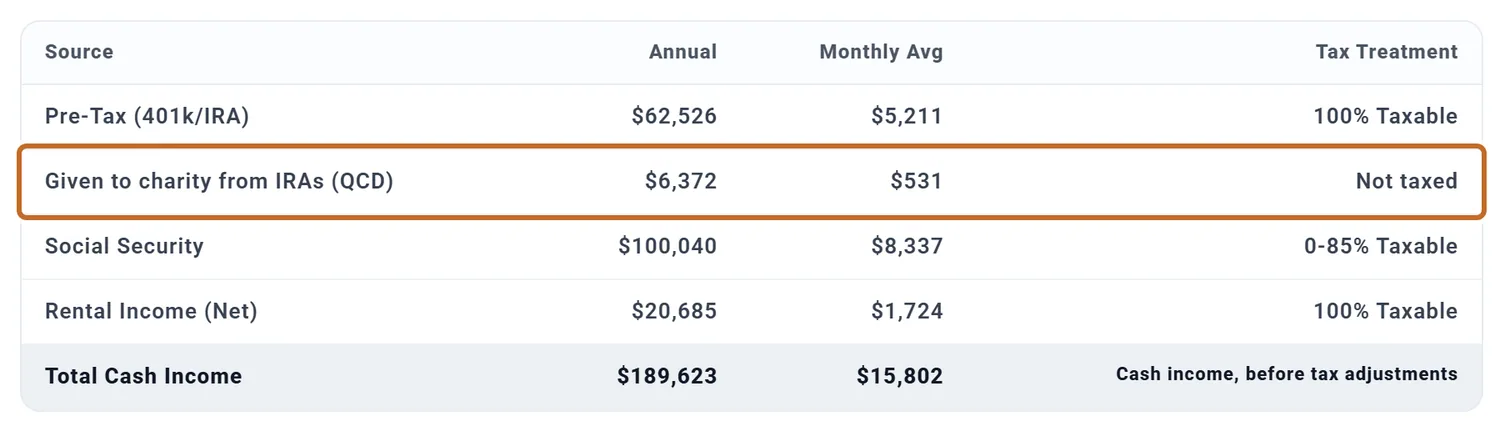
Open Charts & Data, choose Taxes, and press Tax Details on a year with a gift. The gift is a row of its own, marked Not taxed; the pre-tax withdrawals above it are only what was taxed.
What the plan checks
- Before the IRA's owner is 70½ nothing is given, and the card says when the gifts can start.
- Each person gives at most the yearly limit across all of that person's QCD cards, in card order; the card says how much was not given.
- The gift comes only from the IRA you chose and stops if that IRA runs out. Nothing is taken from another account or from cash.
- A SEP or SIMPLE IRA qualifies only in a year no employer money goes into it. The plan does not check that, so choose one only when it is true.
- The gift is never added to your income in any tax year, and from the year required minimum distributions start it counts toward the minimum of the IRA's owner.
Other withdrawals from an IRA count toward the minimum too
Any Extra Withdrawals card that takes money from a pre-tax account after required minimum distributions start (a trip, a car, a gift you Spend it) also counts toward that person's minimum for the year. The plan draws only the rest of the minimum, and the RMDs chart's tooltip says "Met by extra withdrawals". The difference is tax: an ordinary withdrawal is income, a QCD is not.
On a Preview account
Outside the US
A QCD is a US rule. In a Canadian or UK plan the Give to charity (QCD) button and the Give it to charity (QCD) destination are not offered, and a QCD card kept from a US plan gives nothing (it says why). Plan your giving in your budget or on a card with Spend it.
What the planner does not model
- Itemized deductions. The planner always takes the standard deduction, so a gift paid from your budget never lowers your tax in the plan. A QCD does, because it is left out of your income.
- Gifts of shares. Giving appreciated investments instead of cash is not modelled.
- Donor-advised funds and private foundations. Neither can receive a QCD, and giving to them is not modelled beyond a budget line or a card.
- The one-time QCD to a charitable trust or gift annuity, and a QCD from an inherited IRA. Not modelled.
- Deductible IRA contributions after 70½. In real life they reduce how much of a later QCD is left out of income. The plan does not apply that rule.