



 Continue with Google
One month at a time
This page explains, in plain words, how the planner turns your settings into a plan, and what keeps that plan current. You do not need it to use the planner; read it when you want to know where a number comes from.
Your plan starts in the current month and runs month by month until the month of the Primary's Plan ends at birthday, or your spouse's, when they have their own, later Plan End. Every age in the plan comes from the birth dates in your profile, so each person's birthdays fall in the right months.
Each month, the planner:
- Counts the month's income: salary while you work (with Employment Income on), then Social Security, pensions, annuities, rent and the rest, each from its own start date.
- Spends: your spending for that month, raised from today's dollars by your plan's inflation, plus any costs that fall in that month (premiums, milestone expenses, Extra Withdrawals).
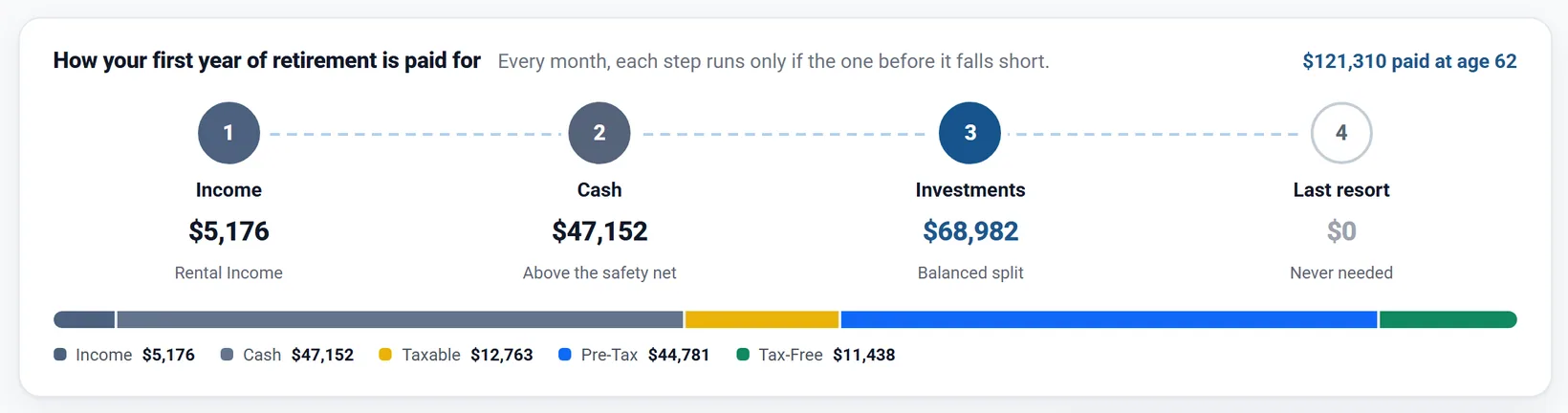
- Pays any gap, including the month's tax, from cash and then your investments, in the order your withdrawal strategy sets. See The order, every month.
- Grows what is left: each account grows by its rate, and the month's growth shows in the next month's balance.
- Saves, while you work: what you set in Retirement Contributions goes into your accounts at the end of the month, a twelfth each month (or all in January, if you chose that).
- Settles the tax once a year: at the end of each full tax year it re-checks the whole year, as a tax return would, and settles the difference. If your plan starts part-way through a tax year, that first part-year keeps its monthly estimates.
Before you retire, the plan models your pay only with Employment Income on. Without it, your saving simply arrives in your accounts each month (see How saving works).
Returns and inflation
- The projection (the Dashboard, Charts & Data, the Summary, Your Taxes and the Optimizer) uses the rates you set in Returns and Allocations: one return for stocks, one for bonds and one inflation rate, every year, unless you shape them by age. Your mix of stocks and bonds blends the two returns.
- Some money has its own rate: each cash account, an HSA, a TIPS ladder, and your home's appreciation.
- Chance of Success replays your plan through real market history since 1871 instead, with each period's own returns and inflation. See Why it differs from the Dashboard.
So the projection is one steady path, not a forecast: real markets rise and fall around it. The two views together show both the shape of your plan and how sturdy it is.
How the tax is worked out
- Every kind of income is taxed by its own rules: pay, Social Security, pensions, withdrawals by account type, gains, interest and the rest. In the US that is federal and state tax, plus payroll tax while you work; in Canada and the UK, their own systems.
- Tax is estimated each month and settled at the end of each full tax year, so a big month (a sale, a Roth conversion) is taxed with the rest of its year. See Settlements.
- The plan uses the 2026 tax tables. Each later year, brackets and deductions grow once, in January, by your plan's inflation, standing in for the yearly adjustments the law makes. Contribution limits also rise with your plan's inflation, and each year's limit uses the age you reach that year.
- Amounts the law does not index stay the same every year. US For example, the income levels at which Social Security becomes taxable ($25,000 and $34,000 for a single person, $32,000 and $44,000 for a married couple filing jointly) and the levels for the 3.8% tax on investment income ($200,000 single, $250,000 joint) never rise, so a growing income passes them over time.
For what each figure means, see Your Taxes.
Keeping your plan up to date
Your plan starts again from today each time you open or recalculate it, with the balances you last entered. So:
- Update your balances every few months on Accounts & Assets. The planner never fetches them, so an old balance stays as typed. Each day you change them, it records a progress point, so you can follow your net worth over time (see Progress points).
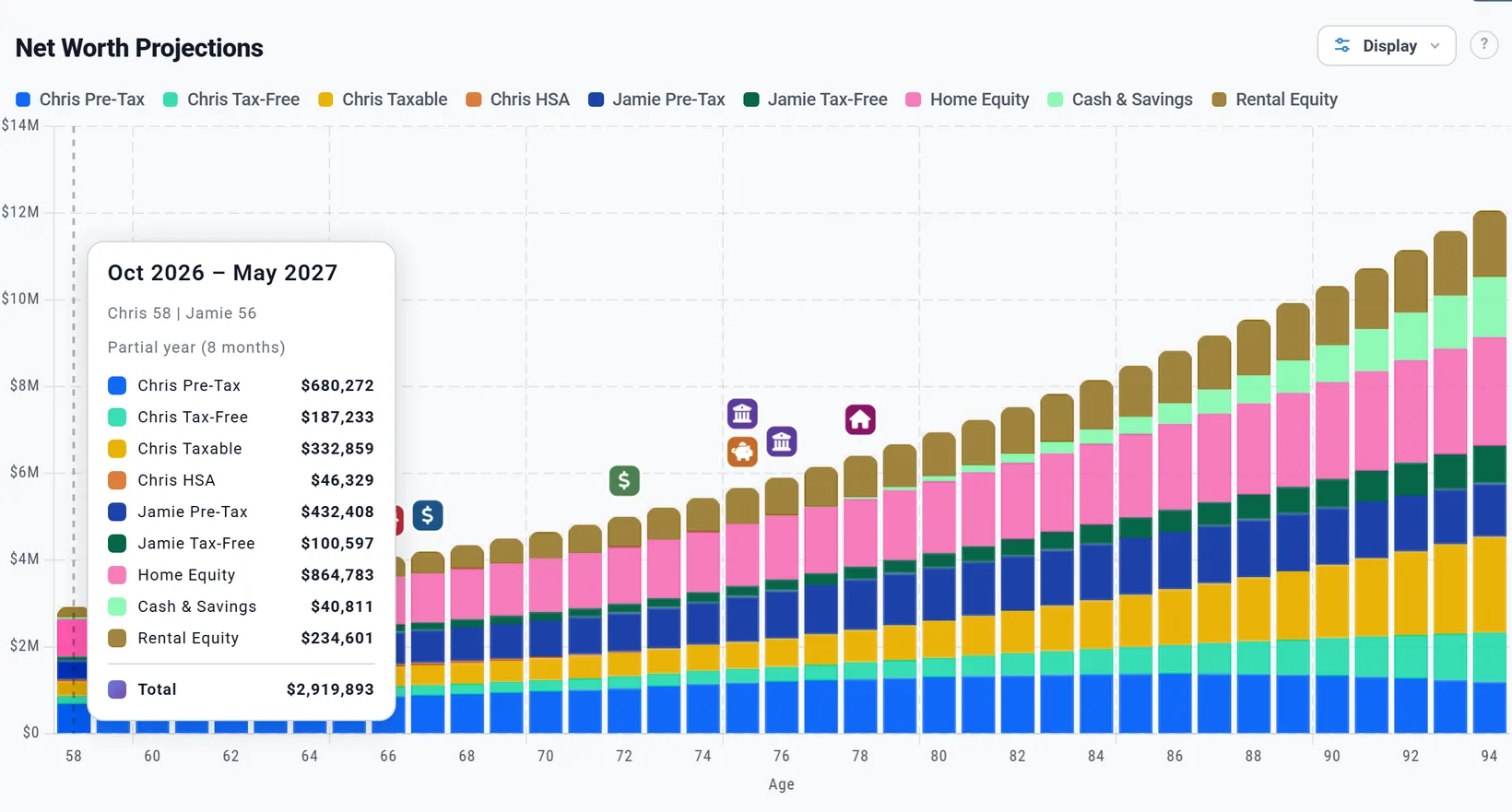
- Ages and dates look after themselves. They come from your birth dates and today's date. The first yearly bar runs from this month to the Primary's next birthday, so it is usually short.
- Revisit the plan after a change in your life: a new job or salary, a move to another state, a marriage, an inheritance, a new pension statement or Social Security estimate.
- Once a year, look over your spending and your Returns and Allocations assumptions.
Why did my results change when I changed nothing?
- A new month began. The plan now starts a month later with the same balances, so it has one month less of saving and growth before you retire. Small drops from month to month usually mean your balances need updating.
- A birthday passed. Ages, the first bar and the bars after it move by a year.
- Something shared changed in another plan. Accounts, your home and loans belong to every plan (see What belongs to you, and what belongs to a plan).
- The planner was updated, for example with a new year's tax rules or a fix. The Release Notes list what changed.
What a projection can and cannot tell you
- It shows what your settings lead to, not what will happen. Markets, tax law and your own life will differ.
- It is only as good as what you enter. Common mistakes lists the slips we see most often.
- For the list of what the planner includes and leaves out, see the Learning Library article What ReadyAimRetire Models.