


 Continue with Google
Set your plan to the UK
Every new plan starts in the United States. Change the country first, so the planner uses UK tax rules, the State Pension and UK account types.
- In your profile (the first box in the settings panel), open Location and choose United Kingdom.
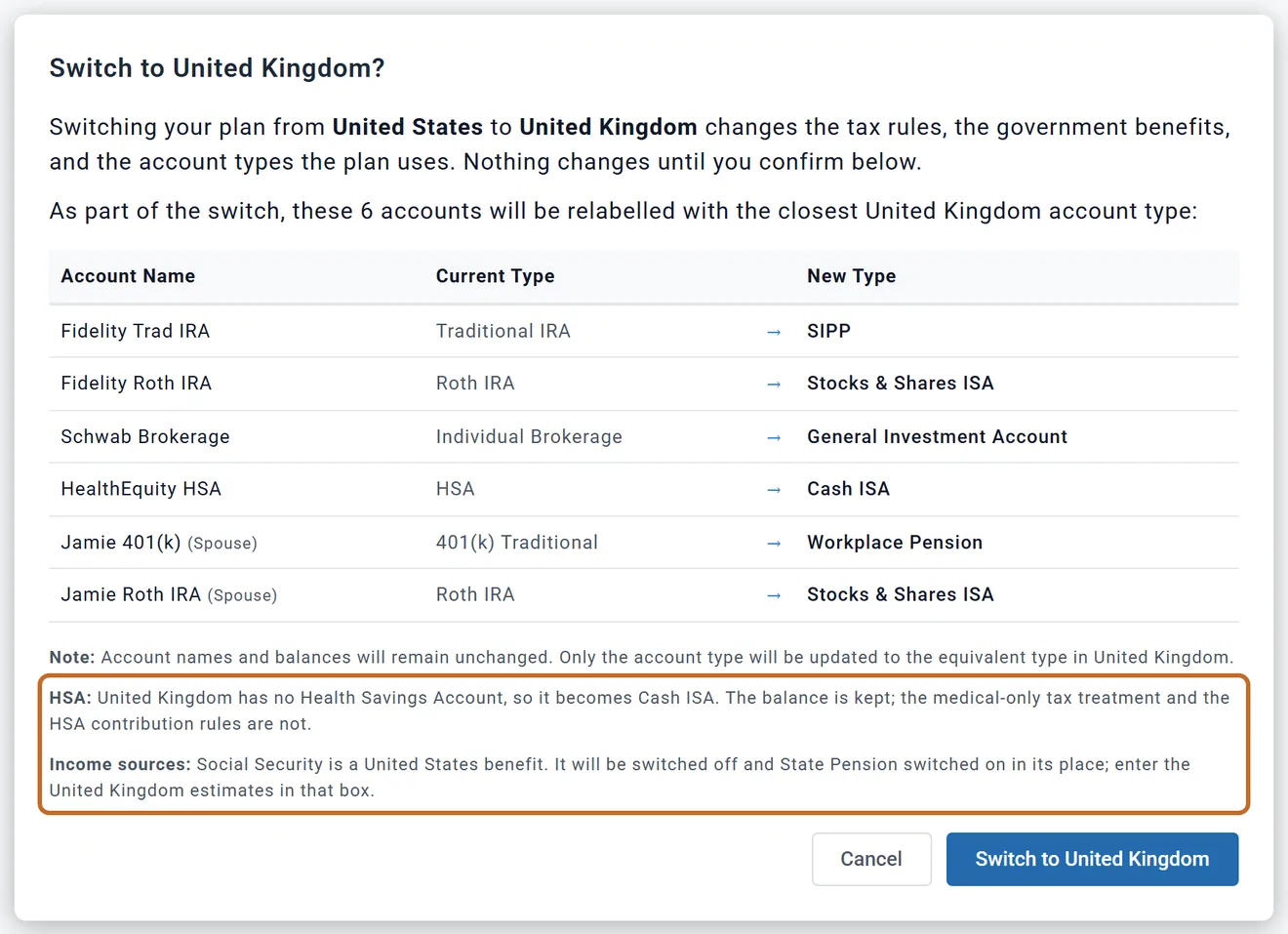
- If any of your accounts has a US type, Switch to United Kingdom? opens. It lists each account with its new type and, if you have them, says what happens to an HSA and to Social Security.
- Choose Switch to United Kingdom. Nothing changes until you do; Cancel keeps the United States.
- Choose your UK region (see below).
What the switch changes
- Account types. 401(k), 403(b) and 457 become Workplace Pension; traditional, SEP, SIMPLE and rollover IRAs become SIPP; Roth accounts become Stocks & Shares ISA; an HSA becomes Cash ISA; a brokerage account or a 529 becomes General Investment Account (a joint one Joint GIA). Inherited IRAs are not converted.
- Your accounts are shared by every plan, so the UK types show in all your plans. Switching back to the United States gives the old types back (see Your accounts, home and loans).
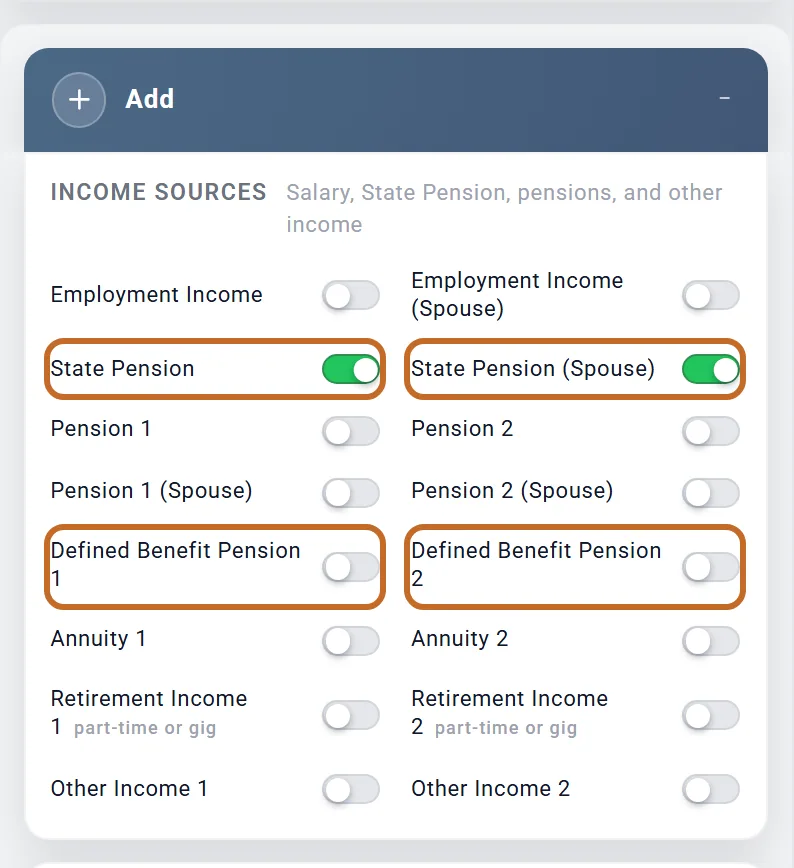
- Income boxes. Social Security switches off and State Pension (and State Pension (Spouse)) switches on. US-only boxes switch off and leave the Add box: Deferred Compensation, TIPS Ladders, Roth Conversions, the HSA, 72(t) Payments and Health Care. What they held comes back if you return to the United States.
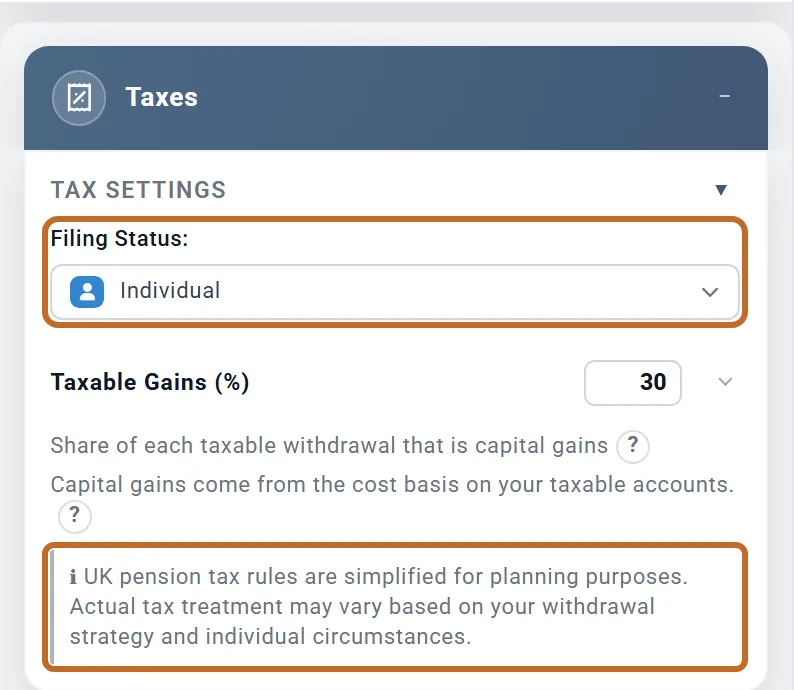
- Filing Status offers one choice, Individual. A couple is still taxed as two people (see Couples).
- Starting values you never changed move to UK ones: inflation 3.2% becomes 2.5% and stocks 8% become 7.5% (bonds stay at 4%); a spending amount still at the starting $5,800 a month becomes £2,000, and a retirement age still at 65 becomes 66. Values you set yourself stay: Chris and Jamie kept their 8,500 a month and their ages, 62 and 63, while their inflation and stock returns moved.
- The required-minimums switch is turned off: the UK has none.
- Typed dividends, a US locality and the government-pension ticks on Pension boxes are cleared.
Your UK region
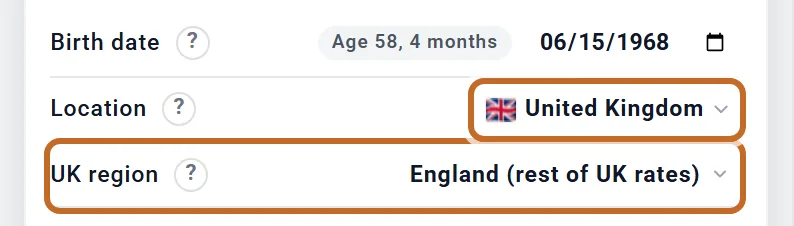
A UK plan has a UK region row under Location (US states are hidden):
- England (rest of UK rates), the starting choice. Wales and Northern Ireland use the same income tax bands.
- Scotland (Scottish Rate of Income Tax) uses the Scottish rates and bands for income tax.
Its "?" opens UK Region & Scottish Rate of Income Tax with each region's bands. Every switch into the UK sets the region to England, so choose Scotland after you switch, and again if you ever switch away and back.
Your accounts: pensions, ISAs and GIAs
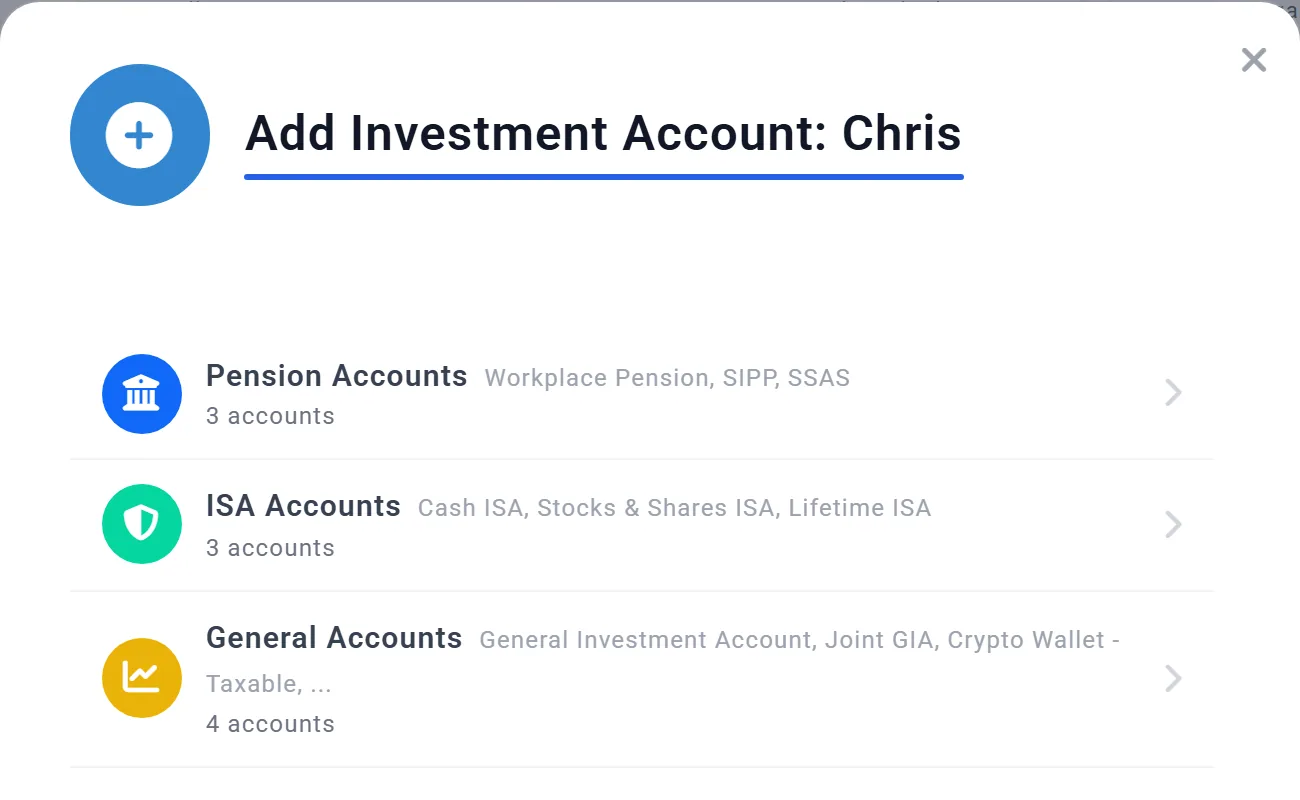
On Accounts & Assets, a UK plan offers three groups of investment accounts:
- Pension Accounts: Workplace Pension, SIPP and SSAS.
- ISA Accounts: Cash ISA, Stocks & Shares ISA and Lifetime ISA.
- General Accounts: General Investment Account, Joint GIA, a taxable crypto wallet and a trust account.
Cash, your home, property, other assets and debts work as in the US. Adding an account needs Planner+. Planner+
Across the planner the three kinds are called Pension/SIPP, ISA and GIA. This is how each is taxed when you draw from it:
| Account | When you draw from it |
|---|---|
| Pensions (Workplace Pension, SIPP, SSAS) | 25% of each withdrawal is tax-free and 75% is taxed as income, until your tax-free total reaches the £268,275 Lump Sum Allowance; after that all of it is taxed (see Drawing your pension). |
| ISAs | Tax-free. A Cash ISA and a Stocks & Shares ISA are treated the same. |
| GIAs | Only the gain is taxed, as a capital gain. The gain comes from the account's cost basis, or from Taxable Gains (%) in the Taxes box. |
- Interest on your cash is taxed as savings income, with the two 0% allowances UK savers get (see Interest on cash).
- Interest and dividends inside a GIA are not taxed each year. The Taxes box has no Investment Income card in a UK plan. With a large GIA your tax can read low.
- Lifetime ISA: up to £4,000 a year, inside the £20,000 ISA allowance, with a 25% bonus on each deposit and no deposits from 50. The plan does not draw it before 60, so it never charges the withdrawal charge.
- Growth: every account grows at your plan's allocation. Per-account growth is not available for UK plans yet; the account window says so.
- A main home's whole gain is exempt when you sell. Rent from a property your spouse owns is taxed on your spouse's own return.
The State Pension
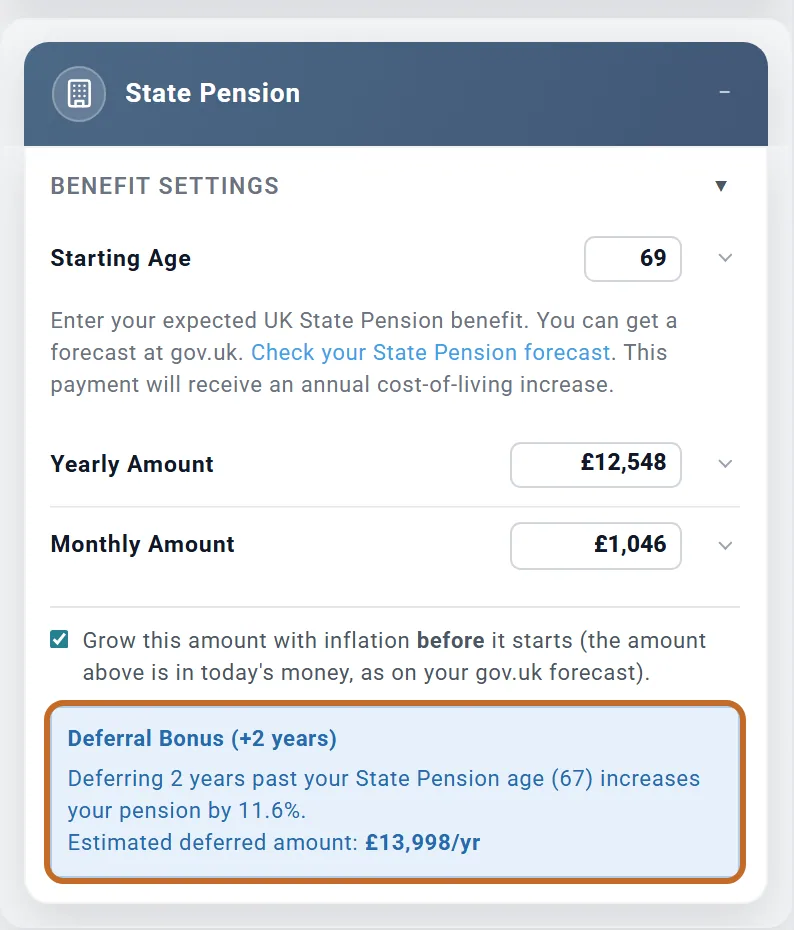
The switch puts State Pension (and State Pension (Spouse) for a couple) in place of Social Security, with example amounts: £12,548 a year for you. Replace them with your forecasts from gov.uk.
- It cannot start before your State Pension age, which the planner works out from your birth date (67 for Chris, born in 1968). Each year you put it off adds about 5.8%.
- It rises each April by the triple lock and is taxed as income. There is no National Insurance record to enter.
- When one of you dies, their State Pension stops; there is no survivor State Pension.
The box is explained step by step in Social Security and government pensions.
Income tax, National Insurance and capital gains
Income tax
- 2026/27 bands: a £12,570 Personal Allowance, then 20% to £50,270, 40% to £125,140 and 45% above. The allowance falls by £1 for every £2 of income over £100,000; the tax-free 25% of pension withdrawals is left out of that test.
- The thresholds stay frozen through the 2030/31 tax year. From April 2031 the plan raises them each year with your plan's inflation. The £100,000 point and the National Insurance thresholds are never raised.
- Scotland: the Scottish bands (19%, 20%, 21%, 42%, 45% and 48%) on the same Personal Allowance. They stay at this year's figures; only the allowance under them moves. Capital gains use the UK bands everywhere.
- Rent: from the 2027/28 tax year, net rent in England and Northern Ireland is taxed at 22%, 42% and 47%. Tax Details shows it as Property Basic Rate and so on. Scotland and Wales keep the ordinary rates.
- Taxed as income: the State Pension, Pension 1 and 2, Defined Benefit pensions, the taxable part of an annuity or of Other Income, salary, rent and the taxed 75% of pension withdrawals.
Interest on cash
The interest your cash accounts earn is savings income. The plan taxes it the month after it is paid, on top of your other income, in three steps:
- Starting rate for savings: up to £5,000 of interest at 0%. Every £1 of other income above your Personal Allowance takes £1 off it, so it is gone once that income passes £17,570.
- Personal Savings Allowance: the next £1,000 at 0%, or £500 if any of your income reaches the higher rate, and none at the additional rate.
- The rest at 20%, 40% or 45%, by the band it lands in. From April 2027 these are 22%, 42% and 47%.
- The interest counts toward the £100,000 point where the Personal Allowance starts to fall, and it fills up the bands your capital gains are taxed in.
- In Scotland the interest still uses the UK rates and bands, not the Scottish ones.
- A couple's interest is split by who holds the cash accounts, and each of you uses your own allowances.
- Tax Details lists it as Interest on cash (savings income), and the bands as Savings Starting Rate, Personal Savings Allowance and Savings Basic Rate (and Higher or Additional). Planner+
National Insurance
- Employment Income pays Class 1: 8% between £12,570 and £50,270 and 2% above, per person, until that person's State Pension age. Pension contributions from pay lower your income tax, not your National Insurance (salary sacrifice is not modelled).
- Retirement Income pays Class 1 too, or Class 4 (6% and 2%) when you tick This is self-employed income. Both stop at the State Pension age of whoever earns it (Who earns it in the box).
- Pensions, withdrawals and rent pay no National Insurance.
Capital gains
18% and 24% above a £3,000 yearly exemption, which is not raised. Each of you has your own exemption and bands. Gains on selling property or other assets sit on the Primary's return.
The Taxes box
Filing Status shows Individual, and a note says UK pension tax rules are simplified for planning. Taxable Gains (%) works as in the US.
See your tax
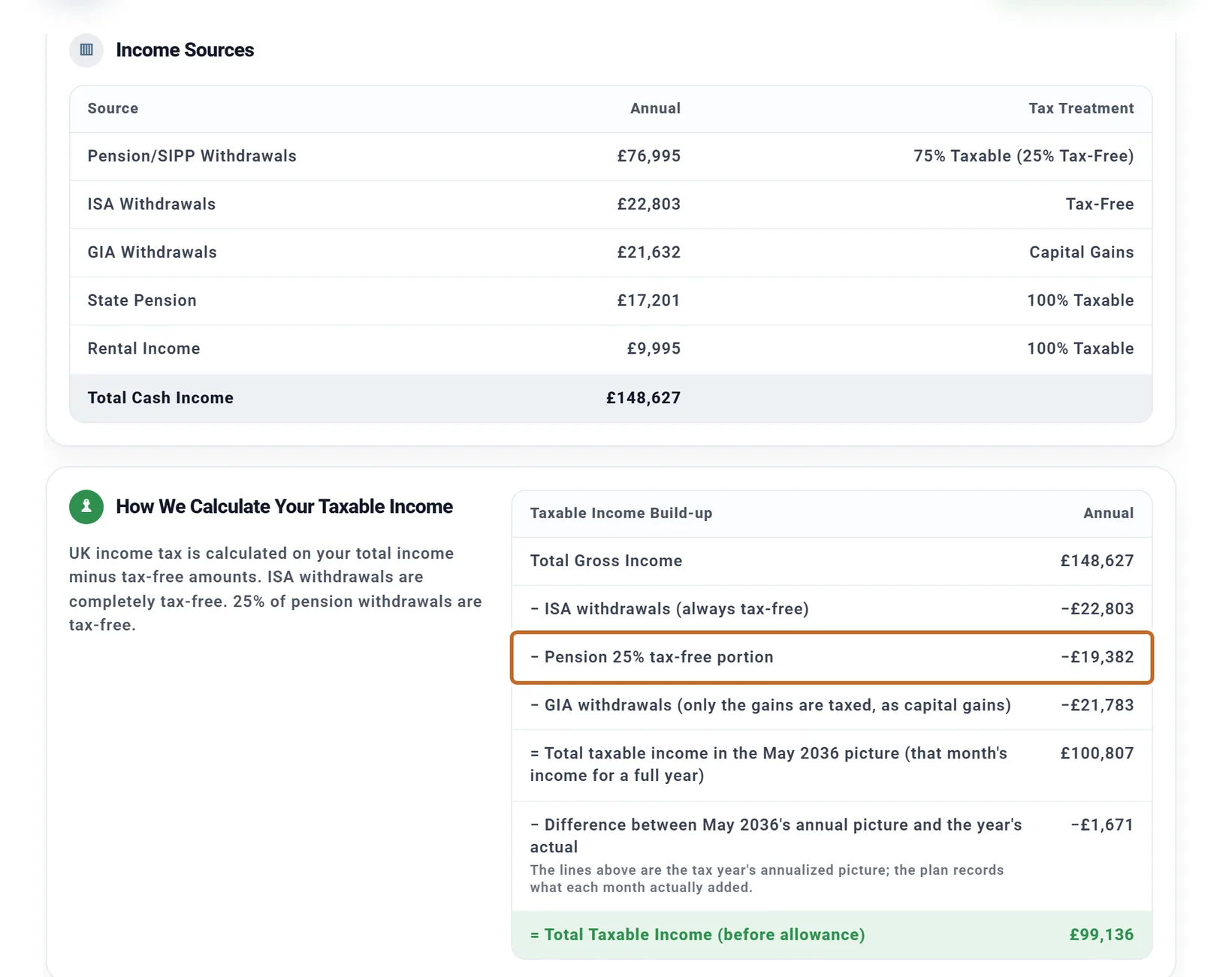
The Taxes chart's bands are Income Tax (Ordinary), Capital Gains Tax, National Insurance (while someone works) and Property Tax. On Charts & Data, the Taxes table's Tax Details button shows a year's sums: ISA withdrawals and the pension's 25% are taken out first, then the Personal Allowance (marked "(Tapered)" above £100,000), the bands and Income Tax Band Analysis (UK). Planner+
More in Your Taxes and Reading your results.
Drawing your pension
The tax-free 25%
- Pension accounts (SIPP, workplace pension): 25% of every withdrawal is tax-free, as each payment is made. The plan does not take one tax-free lump sum at the start. Each of you has your own £268,275 Lump Sum Allowance, used up as you draw; it is not raised with inflation. After it is used up, every pound you draw is taxed.
- Pension boxes (Pension 1 and 2, Defined Benefit Pension 1 and 2): a tax-free lump sum from the scheme is not modelled; the whole pension is taxed as income (see Pensions and annuities).
The minimum pension age
- A pension can be drawn from 55, and from 57 once the tax year starting 6 April 2028 begins, for everyone. Someone who is 55 or 56 then is locked again until 57. Protected pension ages are not modelled.
- Before that age the plan never draws your pension, in any mode. Your spending comes from ISAs, GIAs and cash, and a month nothing else can pay shows as a shortfall. For a couple, only the pension of whoever is under the age waits. Extra Withdrawals cannot reach a locked pension either.
- For example, someone born in June 1972 who retires at 54: the plan draws their pension from June 2027, when they turn 55, to March 2028, then not again until June 2029, at 57.
No required withdrawals, and a cap on saving after you draw
- There are no required minimum withdrawals: no minimums switch in the Retirement Spending box or the Withdrawal Planner, and no RMDs chart.
- Your first pension withdrawal, of any size, caps what can go into your pensions at £10,000 a year from then on (the Money Purchase Annual Allowance). This matters if you start drawing while you, or your employer, still pay in.
The order of withdrawals
Your withdrawal strategy works as in the US (see Where your spending money comes from). The presets and the custom mix still say Pre-Tax, Tax-Free and Taxable: in a UK plan those are your pensions, ISAs and GIAs.
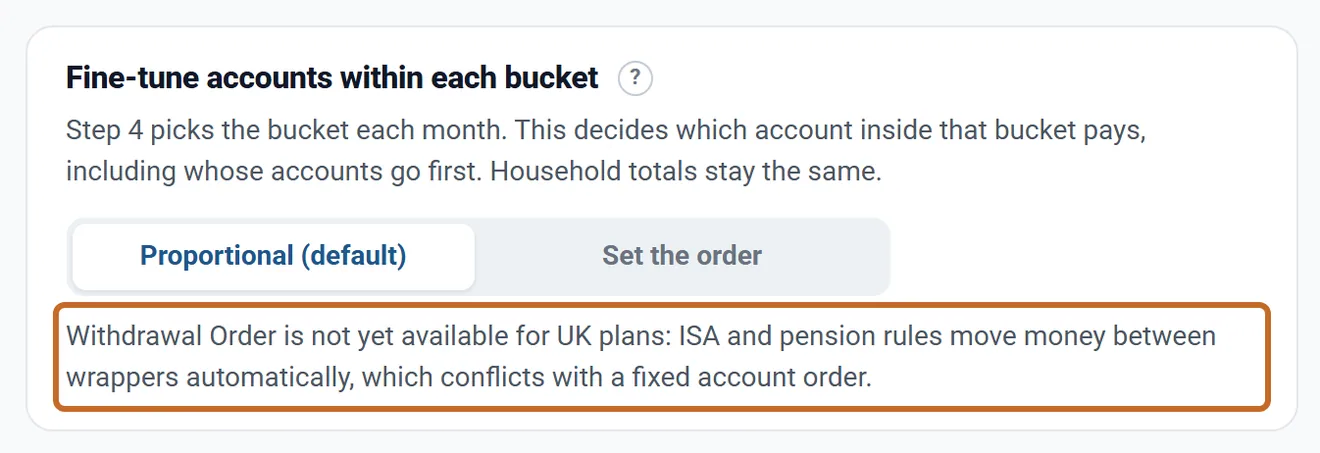
- Set the order is not available, so accounts in one bucket are drawn in proportion to their balances.
- There is no "Whose accounts" line: the rule that holds back a working spouse's accounts in US and Canadian plans does not apply in a UK plan.
- In place of Roth conversions, the Optimizer's Bracket Filling can draw extra from your pensions in low-income years, up to the top of the 20% band or toward the higher-rate band, stopping at the £100,000 allowance taper. See Roth conversions and tax strategy.
Saving: pension and ISA allowances
Unlike US and Canadian plans, a UK plan applies its allowances in Simple and Advanced contributions alike:
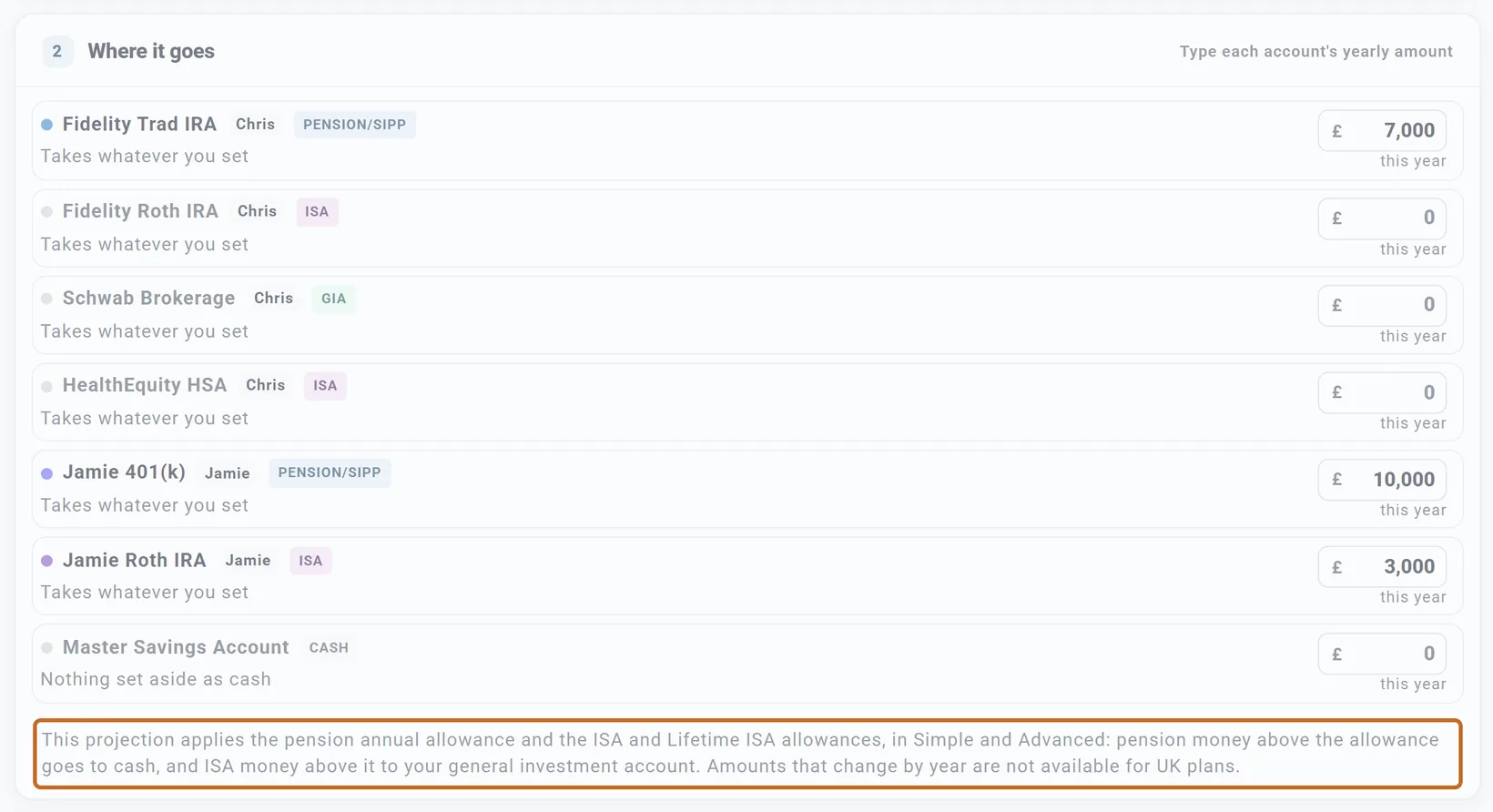
- Pensions: £60,000 per person per tax year (your employer's money included). For high earners (adjusted income over £260,000 and threshold income over £200,000) it tapers by £1 for every £2, down to £10,000, worked out from your plan's own pay and contributions. After a first pension withdrawal it is £10,000 (see above).
- ISAs: £20,000 per person per tax year, across Cash, Stocks & Shares and Lifetime ISAs, with at most £4,000 of it in a Lifetime ISA.
- The allowances start again each April and are not raised with inflation. Unused allowance is not carried forward.
Money over an allowance is not lost:
- Pension money above the allowance lands in cash, with no tax relief. There is no Annual Allowance charge.
- ISA money above £20,000 goes to your GIA.
- Lifetime ISA money above £4,000, or paid in from 50, goes to your other ISAs first.
- Employer contributions go to a workplace pension; an ISA cannot receive them, and the Employment Income box warns you if you hold no workplace pension.
On the Contribution Planner you type one yearly amount per account, and it applies to every working year (amounts that change by year are for US and Canadian plans). The note under the list says the allowances apply. The list labels your accounts the UK way: Pension/SIPP, ISA and GIA.
- Deposit timing: Monthly or All in April, which puts each year's deposits in April, the first month of the UK tax year.
- More on saving: Saving before you retire.
The April tax year
The UK tax year runs from 6 April to 5 April. The planner works in whole months, so its tax year is April to March. Each April:
- the pension, ISA and Lifetime ISA allowances start again;
- the State Pension rises, and from April 2031 the tax thresholds move;
- bracket filling is planned, and milestone conditions and Spending Guardrails are checked;
- "All in April" deposits land;
- the minimum pension age test uses the tax year (57 from April 2028).
At the end of each full April to March year the plan works the tax out again on the year's actual income and settles the difference.
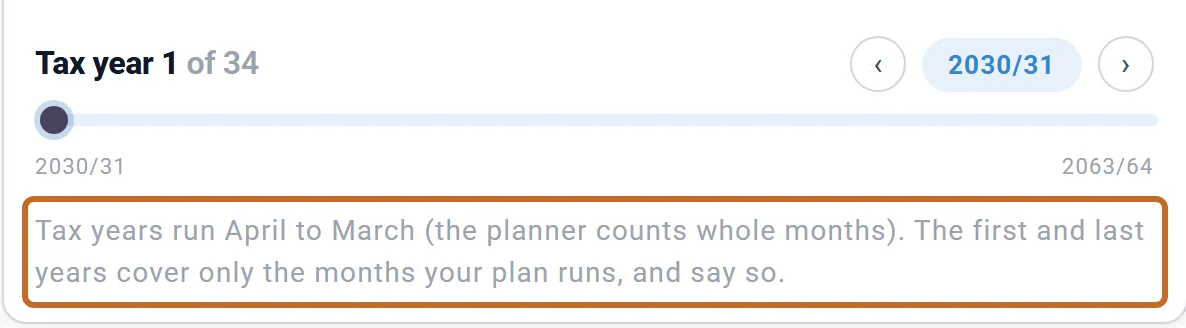
On Your Taxes, By tax year labels each year "2030/31", and the Dashboard tax charts do the same (see Your Taxes).
Couples
- With Include spouse on, each of you is taxed on your own return: your own allowance and taper, bands, capital gains exemption and Lump Sum Allowance.
- On each owner's return: the State Pension, Pension 1 and 2 (and the Spouse boxes), salary, rent, Other Income, Retirement Income (by Who earns it), interest on cash (by whose cash accounts hold it), and pension withdrawals by whose account paid. On the Primary's: Defined Benefit pensions, annuities, and anything with no owner.
- Bracket filling fills each person's band separately.
- After a death, the survivor's draws from the late spouse's pension pot are a beneficiary's: tax-free if the spouse died before 75, fully taxed (no 25%) at 75 or over. The survivor can draw it at any age, and keeps their own Lump Sum Allowance.
- Marriage Allowance is not modelled.
See Planning as a couple.
Inheritance tax on the Estate tab
In a UK plan the Estate tab adds a UK Inheritance Tax panel, and a UK Inheritance Tax line in the Asset & Cost Ledger. Planner+
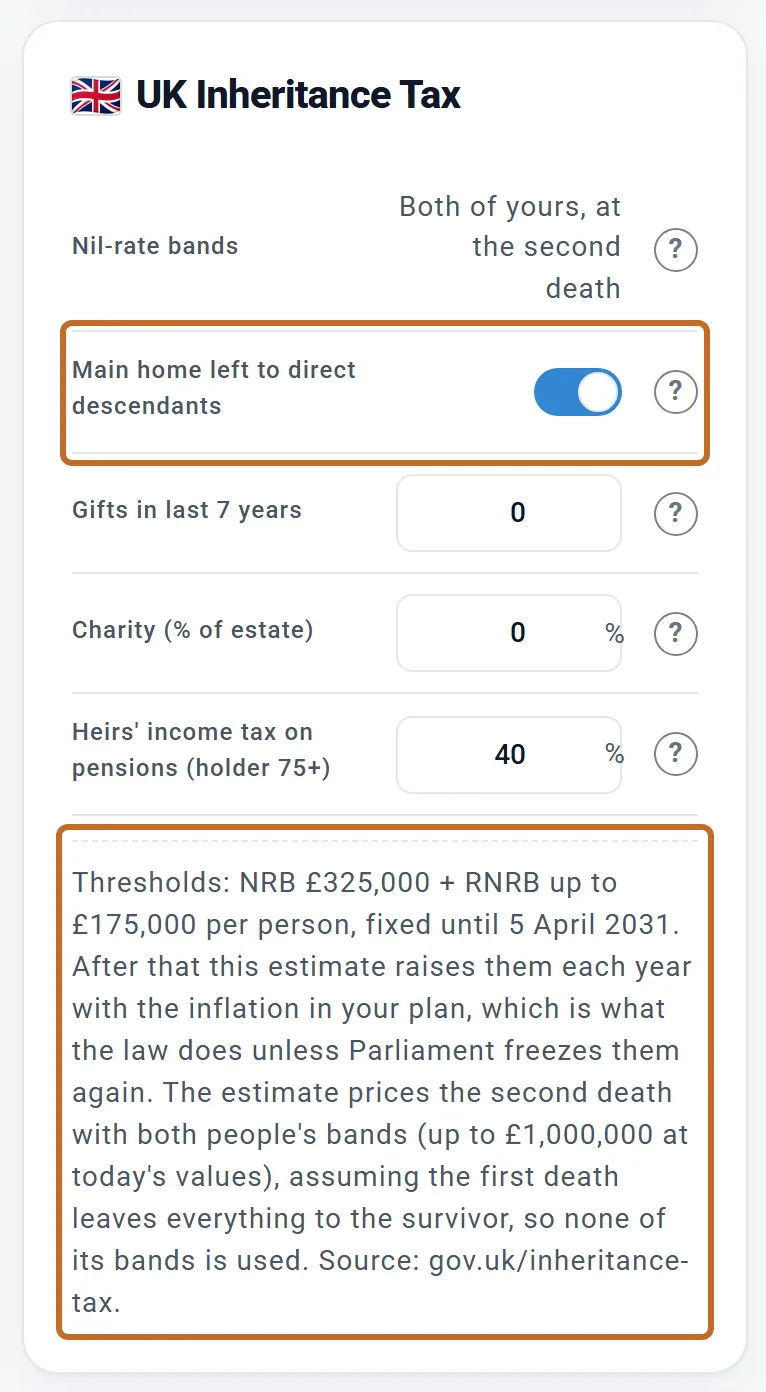
- Main home left to direct descendants (on to start with), Gifts in last 7 years, Charity (% of estate) and Heirs' income tax on pensions (holder 75+) (40% to start with).
- It prices the last death: a £325,000 nil-rate band, plus up to £175,000 more when your home goes to your children or grandchildren, but no more than the home is worth after its mortgage (no home on Accounts & Assets, no extra band). That extra band shrinks by £1 for every £2 the estate is over £2,000,000.
- A couple's plan uses both people's bands at the second death (up to £1,000,000), assuming the first death leaves everything to the survivor. In a plan for one person, Marital status Married / widowed adds your late spouse's bands at the share they left unused (Late spouse's bands unused, 100% to start with); Single adds none.
- The tax is 40%, or 36% when at least 10% goes to charity. Gifts in the last 7 years use up the nil-rate band first.
- The bands are fixed until 5 April 2031, then raised each year with your plan's inflation.
- Pensions count in the estate when the death falls in the 2027/28 tax year or later. If the holder died at 75 or over, heirs also pay income tax on the pension at the rate you set, after the pension's share of inheritance tax. ISAs and GIAs are in the estate too.
- The US rate inputs are hidden; Asset Liquidation, Admin Costs and Charitable Giving stay. Probate is not calculated.
What you will not see in a UK plan
- Boxes: Social Security, Deferred Compensation, TIPS Ladders, Roth Conversions, the HSA, 72(t) Payments and Health Care. NHS and private cover costs are not modelled either: add health costs to your spending or budget. The Add box offers Defined Benefit Pension 1 and Defined Benefit Pension 2 instead, and Tax Planning lists only the Optimizer.
- Taxes: no state or local tax, no NIIT, no 10% early-withdrawal penalty, no Medicare or IRMAA, and no required minimums.
- Charts: no Social Security, IRMAA, Roth Conversions, TIPS Ladder, Healthcare & HSA or RMDs chart.
- Withdrawals: no minimums switch, no Set the order and no Whose accounts line.
- Summary: no "How you compare" or "Income thresholds" card; the taxes card is "Lifetime taxes", with no Medicare.
- Learning Library: the articles on required minimums, Social Security, IRMAA, health insurance before Medicare, early withdrawals and how you stack up are hidden.
On a Preview account
- Open to everyone: changing Location and UK region; State Pension and State Pension (Spouse), amounts included; Defined Benefit Pension 1 and 2; the Optimizer and Bracket Filling; typing yearly amounts on the Contribution Planner.
- Planner+: the amounts in Pension 1 and Pension 2; adding an account; the Estate tab (blurred, with its UK panel); Tax Details, Your Taxes below its top figures and the Dashboard charts other than the portfolio, as in the US. Planner+
- The Withdrawal Planner's order card shows the UK note, since Set the order is not available for UK plans on any account.
What the planner does not model in the UK
- Income tax on interest and dividends inside a GIA, and so the Dividend Allowance. (Interest on cash is taxed: see Interest on cash.)
- Marriage Allowance, voluntary Class 2 National Insurance and salary sacrifice.
- The State Pension before 2016, your National Insurance record and qualifying years, and any survivor State Pension.
- Protected pension ages, a single tax-free lump sum at the start, a tax-free lump sum from a pension scheme, and lump-sum protections above £268,275.
- Carrying forward unused pension allowance, and the Annual Allowance charge.
- The Lifetime ISA withdrawal charge and first-home use (the Lifetime ISA is held until 60), its "open by 40" rule, and Junior ISAs.
- The Section 24 limit on mortgage interest for rentals.
- Inheritance tax bands passed on from a late spouse, and probate.
- Growth set per account, and a fixed withdrawal order.
- UK market history: Chance of Success uses US market history and inflation (see Chance of Success and guardrails).
- Currency conversion when you switch country.
For the full list of what the planner includes and leaves out, see the Learning Library article What ReadyAimRetire Models.