



 Continue with Google
The words the planner uses, in plain English, with a link to the page that shows each one. At the end: what common words from other planners are called here.
Words in the planner
- Age-year
- A year from one of the Primary's birthdays to the next. Yearly charts and tables use age-years unless you choose By year, so "age 73" can run from September to August. Reading your results
- Buckets: Pre-Tax, Tax-Free, Taxable
- The three kinds of investment account, by how they are taxed: Pre-Tax (traditional 401(k)s and
IRAs: taxed when you take money out), Tax-Free (Roth accounts) and Taxable
(brokerage accounts: taxed on gains). HSAs and cash are kept apart.
Account types
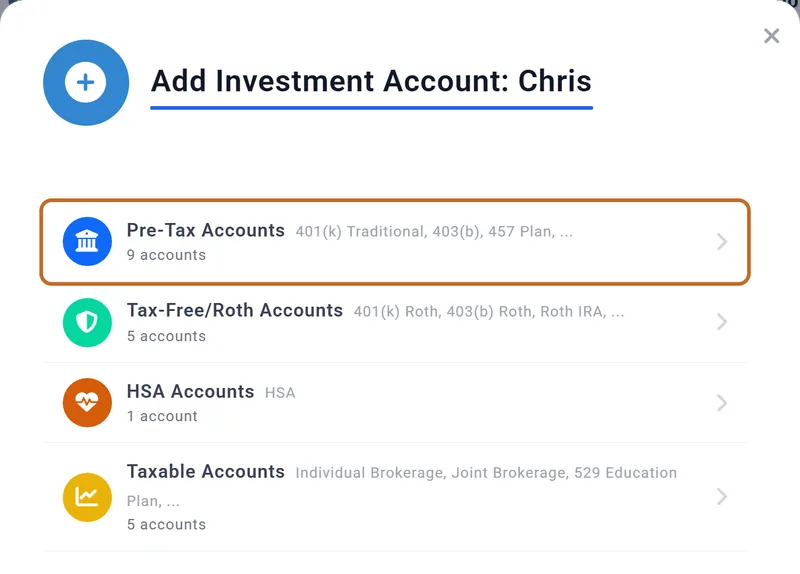
The kinds of account, when you add one. - Cash choices: Spend cash first, Hold cash in reserve, Custom amounts
- When cash pays your retirement spending: before your investments (the default), only once they run out, or up to a yearly amount you draw. Set on the Withdrawal Planner in Advanced. When your cash gets spent
- Chance of Success
- The share of historical trials in which your plan never runs out of savings. Each trial replays your plan through real market history from one start year since 1871; nothing is random. Chance of Success and guardrails
- Coach
- Suggestions about your plan on the Summary tab, each with a link to the setting it is about. Planner+
- Desired Monthly Spending
- What you want to spend each month in retirement, after tax and in today's dollars. The plan adds the tax its withdrawals cause and raises the amount with inflation. Spending and your budget
- Employment Income
- Salary before you retire, for each person, with employer contributions and self-employment. It pays your spending in your working years. Where to enter your income
- Extra Withdrawals
- One-off or repeating amounts on top of your regular spending (a roof, a car), from an account type or one named account, or moved between accounts. A switch on each card sets whether its amount is in today's dollars and grows with inflation, or stays fixed. Take a set amount from one account
- Future dollars and today's dollars
- Future dollars are the amounts in the year they happen. Today's dollars take inflation out, so a number reads as what it would buy now. Reading your results
- Guardrails (Spending Guardrails)
- A Chance of Success setting that cuts or raises spending when markets move your savings far enough. They work only in Monthly Expenses mode. Spending Guardrails
- Master Plan
- Your main plan. Named plans are copies you change to test an idea; Accounts & Assets and your budgets are shared by every plan. Your Master Plan is your baseline
- Milestone
- An event in your plan, at an age (and month) of either of you, that can change your spending or add a cost, among other things. Other settings can start or stop at a milestone. Milestones
- Minimum balance and Safety net floor
- The amount you keep in a cash account; the planner calls the total of your minimums the safety net floor. It is spent only once your investments run out. Keep a minimum in cash
- Named plan
- A plan saved under a name, such as "Retire at 60", to compare with your Master Plan. Planner+ Testing what-ifs with your plans
- One-Time Benefits
- Single amounts you receive, such as an inheritance, added to your savings when they arrive (up to six, each with a name). Where to enter your income
- Optimizer
- A tab that tries other settings for your plan and shows the best it found. Nothing changes until you choose to apply it.
- Plan End (Plan ends at)
- The age your plan runs to. The plan ends at the Primary's Plan End, unless the spouse has a later one of their own. The years after one of you dies
- Planner+ and Preview
- Planner+ is the full planner. A Preview account can build a plan and see its main results; anything that needs Planner+ is blurred or carries a Planner+ note. Getting started
- Primary
- The person in the first profile. Retirement years start when the Primary retires, and charts count the Primary's age. Who is the Primary
- Privacy Mode
- Keeps your plans, budgets and accounts in your browser instead of on our servers. You back them up yourself. Privacy Mode
- Retire at and Retire in
- The age, and the month, a person stops working. Pay and saving stop before that month; retirement spending starts in the Primary's. Retiring at different times
- Retirement Income and Other Income
- Retirement Income is part-time pay in retirement. Other Income is any other regular income you choose the tax treatment for. Rent from a property on Accounts & Assets is counted already. Where to enter your income
- Spending modes
- Monthly Expenses (what you want to spend; the plan takes only the gap from savings), Monthly Income (a set withdrawal before tax) and Using the 4% Rule (a share of your investments in your first retirement month, then the same amount rising with inflation). Set in the Retirement Spending box. Spending and your budget
- Spending Smile
- A curve that lowers spending in the middle of retirement and raises it later, as studies of retirees find. The Spending Smile
- Tax moves
- Roth conversions and bracket filling set in the Optimizer. They happen before your withdrawal strategy splits the rest. Tax moves come first
- TIPS Ladder
- A pre-tax account of inflation-protected bonds that pays you a set real amount each year of a chosen span. US Account types
- Use Budget
- Links a budget from the Budget tab to your plan, in place of Desired Monthly Spending. A budget does nothing until it is linked. Planner+ Spending and your budget
- What's Counted
- Switches that leave a box or a rental out of one plan without deleting it. Leave something out of one plan
- Withdrawal Planner
- The page where you choose when cash is spent and in what order your accounts pay (Advanced mode); Simple mode picks one strategy in the Retirement Spending box. Where your spending money comes from
- Withdrawal rate
- What your savings paid in a year (spending, the costs beside it and the taxes, less your other income) divided by your savings at the start of that year. Your withdrawal rate
Retirement and tax terms
- ACA (marketplace health insurance) US
- Health cover bought before Medicare, with a premium credit that depends on your income. The plan models it from retirement to 65. Health care costs
- COLA
- A cost-of-living increase to a pension or Social Security each year.
- Early-withdrawal penalty US
- 10% on pre-tax money (and Roth earnings) taken out before 59½, with exceptions such as the Rule of 55 and 72(t) payments. Whose accounts are used first
- Full retirement age (FRA) US
- The age Social Security pays your full benefit, 66 to 67 depending on your birth year. The Social Security box asks for your benefit at that age.
- IRMAA US
- A surcharge on Medicare premiums when your income two years earlier was above a threshold. The plan charges it for you. Health care costs
- Required minimum distribution (RMD)
- The amount you must take from pre-tax accounts each year from 73 or 75 (US), by birth year. Canada's version is the RRIF minimum. Required minimums
- Roth conversion US
- Moving money from a pre-tax account to a Roth account, paying the income tax now so later withdrawals are tax-free.
- Widow's penalty US
- The higher tax a surviving spouse often pays: much the same income, taxed as a single filer from the January after the death. The plan models it when your spouse has their own Plan End. If one of you dies first
- 72(t) payments US
- A series of fixed yearly IRA payments before 59½ with no 10% penalty, kept until the later of five years or 59½. Planner+ Before 59½: 72(t) payments
Words from other planners
If you have used another retirement planner, here is the nearest thing in ReadyAimRetire.
| You may know it as | Here |
|---|---|
| Scenarios, plan versions | Named plans, compared with Compare Plans. Testing what-ifs |
| Base plan | Your Master Plan |
| Money flows, cash flow rules | Extra Withdrawals with a named account, Cash that builds up in retirement, and the Withdrawal Planner. Where your spending money comes from |
| Withdrawal order, drawdown sequence | Withdrawal strategy (presets or a custom mix) |
| Emergency fund | A cash account's minimum balance |
| Monte Carlo, probability of success | Chance of Success (market history replayed, not random trials) |
| Real and nominal dollars | Today's dollars and future dollars |
| Tax-deferred, tax-exempt, non-qualified | Pre-Tax, Tax-Free, Taxable |
| Roth conversion explorer or optimizer | The Roth Conversions box and the Optimizer's tax strategy |
| Windfall, income event | One-Time Benefits |
| One-time expense | Extra Withdrawals, a budget row with an end age, or a milestone expense |
| Milestones, life events | Milestones |